Summary
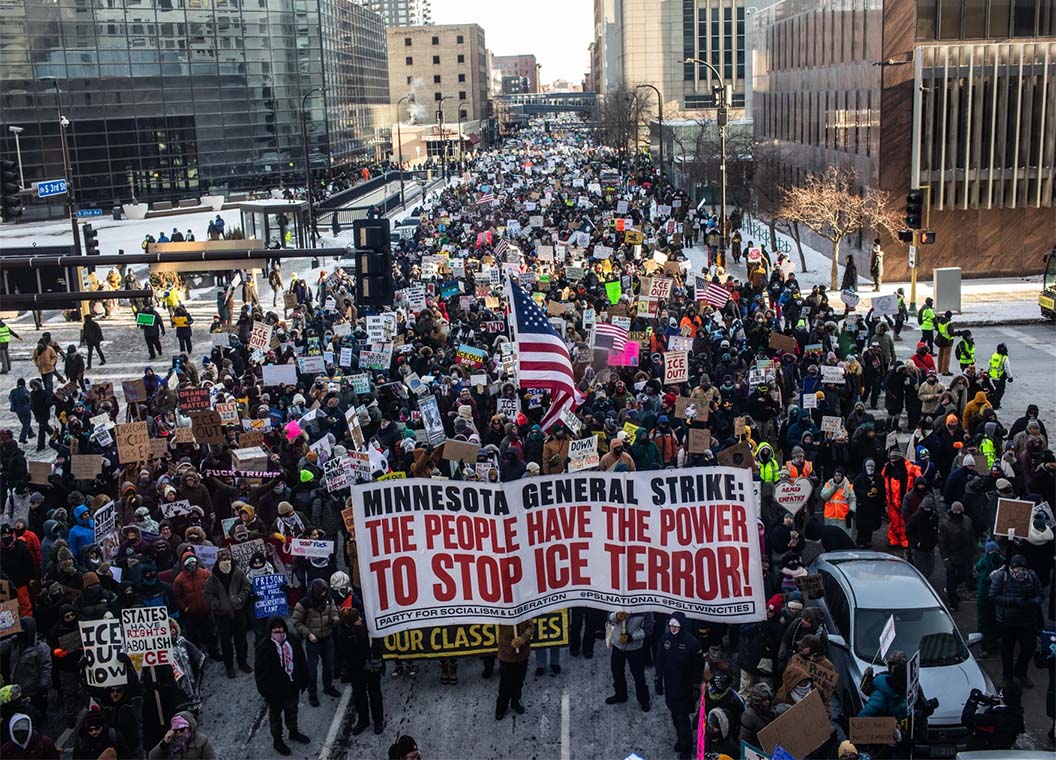
On Friday, 23 January 2026, Minneapolis, USA, was the centre of what became a de facto general strike against racism. There was an enormous day of action, mainly led by the local trade union movement, against an ongoing “surge” by Immigration and Customs Enforcement (ICE), the paramilitary anti-migration force. Many people didn’t go to work, school, or shopping, while perhaps 100,000 people marched through the city centre at midday, despite the arctic temperatures.
Group(s) involved
Trade unions, especially:
Service Employees International Union (SEIU) Local 26: SEIU is a major union, with nearly 2 million members. SEIU Local 26 has 8,000 members in the metropolitan area of the “Twin Cities”, Minneapolis and Saint Paul: property service workers, security guards, janitors, airport workers, Uber/Lyft drivers…
Communications Workers of America (CWA) Local 7250: The CWA has 700,000 members, in the USA, Canada, and Puerto Rico. Local 7250 in Minnesota has about 700 members: AT&T workers, call centre workers, technicians, retail workers, home security technicians, video game workers…
Amalgamated Transit Union (ATU) Local 1005: The ATU has 200,000 members across the USA and Canada. Local 1005, in the Twin Cities area, has over 2,500 members, including bus drivers, light rail operators, rail technicians and other public transport workers.
Minneapolis Regional Labor Federation (MRLF): The MRLF is the AFL-CIO organisation in the Twin Cities area, bringing together over 175 local unions and 80,000 union members.
Minnesota AFL-CIO: The state level labour federation, involving a thousand union branches, and more than 300,000 trade union members.
ICE, US Immigration and Customs Enforcement: ICE forms part of the US Department of Homeland Security. Its stated mission is to “conduct criminal investigations, enforce immigration laws, preserve national security, and protect public safety.” Since its creation under the Homeland Security Act of 2002, it has grown massively, especially under the second presidency of Donald Trump. In 2005 its budget was around $3 billion, in 2025 it was over $10 billion. The Secure America Act and other measures approved in 2026 destined tens of billions of dollars more to ICE. Its agents have been involved in numerous shootings and killings. Concerns have been raised about the hasty, mass recruitment of agents, with little screening or training, with far-right activists being permitted, even encouraged, to join ICE (Holloway 2026).
The events
In early December 2025, the Trump administration announced “Operation Metro Surge,” a mass deployment of the paramilitary Immigration and Customs Enforcement (ICE) in the Twin Cities of Minneapolis and St. Paul. In all, an additional 3,000 ICE officers were sent to the area, as well as a thousand Border Patrol agents (HRW 2026b).
According to SEIU Local 26 President, Greg Nammacher:
“The Trump administration… ordered the ICE occupation of Minnesota in part as a form of political punishment: to retaliate against Governor Tim Walz, but also against our whole state, because of the progressive reputation we have, thanks to state-level pro-worker advances like free school lunches and paid time off for sickness and crisis.”
David Stiggers, President of ATU Local 1005 in Minnesota, thinks the Trump administration sent the ICE surge to the state as a brutal show of power: if they could terrorise Minnesota they could do it anywhere.
Human Rights Watch reported that:
“Thousands of people were arrested during Operation Metro Surge, including at least 4,000 immigrants, the majority of whom had no US criminal history, and many of whose arrests were unlawful.” (HRW 2026b).
Residents of the Twin Cities mobilised massively in the face of this surge, establishing neighbourhood solidarity networks.
Groups of this kind have been created in many areas of the USA affected by ICE incursions, and they carry out diverse activities. One is to warn of the arrival in their area of an ICE patrol, typically with whistles, as well as through their Signal chats. They also give day to day help to migrant families, who often stop going out onto the street out of fear of being deported, so network activists do their shopping. Some local groups give other forms of practical and/or financial support, often including “know your rights” sessions and even legal defence.
Renee Nicole Good, a substitute teacher and US citizen, was active in such a network. She was observing an ICE operation from her car and alerting neighbours when agents fired shots directly at her. They hindered the arrival of medical attention and she died soon after. The Department of Homeland Security described this 37-year-old mother of three as a “violent rioter”, and accused her of trying to kill ICE agents in “an act of domestic terrorism” (X.com post by @DHSgov, 07/01/26).
After studying the videos of the events and other evidence, Human Rights Watch found Good’s killing “unjustifiable”. They pointed to a “broader pattern of incidents involving the use of firearms under questionable circumstances during immigration enforcement operations”. And as Good’s wife declared later: “We had whistles. They had guns” (HRW 2026a).
Over the following weeks there were many other abuses by ICE in Minnesota, including a non-fatal shooting as well as the arrest and imprisonment of a five-year-old boy.
Given all of this, Minnesota trade unions started to discuss what they could do. Apart from their members’ involvement in the neighbourhood “ICE watches”, the idea of a specific labour action was on the table.
According to David Stiggers: “the Renee Good killing was the final catalyst, making it more urgent”.
Greg Nammacher of the SEIU explains:
“By the new year, the work of providing services and mutual aid had started to exhaust us. When ICE murdered Renée Good, it was a wake-up call that we can’t service our way out of an authoritarian occupation of our city. We had to go on offense—create some real pressure on those who were making the decision to occupy our city.” (Nammacher 2026).
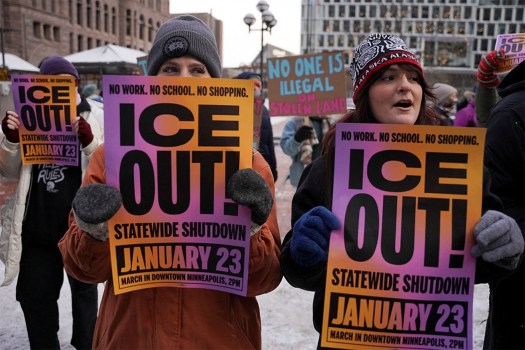
Following the Good killing, community and faith groups proposed a day of “no work, no school, no shopping”. For SEIU Local 26, the ICE surge was a direct attack on their union. Citing Nammacher (2026) again, of the Local’s 8,000 members, “the vast majority… are immigrants and people of color. Thirty of our members were abducted by ICE during the onslaught.” So this local was the first to give trade union backing to the stoppage.
A number of other unions, starting with CWA Local 7250, followed the SEIU’s example. Its president, Kieran Knutson, explained in an interview that “after Renee Good was killed… a lot of us said we have to move now” Payday Report (2026a).
According to Stiggers of the ATU Local 1005, some 25-30% of the workers in transport are migrants; theirs was another of the unions that quickly signed on to the action.
On 19 January, the Minneapolis Regional Labor Federation (MRLF) held a press conference in which its President, Chelsie Glaubitz Gabiou, and leaders of key local union branches declared their backing for the Day of Truth and Freedom (MRLF 2026). Meanwhile, the state-wide trade union body, Minnesota AFL-CIO, also supported the action (Minnesota AFL-CIO 2026).
By the day before, the website Payday Report, which reports and promotes labour struggles in the USA, had registered 300 planned actions for 23 January in cities around the country (Payday Report 2026b). For example, the United Federation of Teachers, representing nearly 200,000 teachers and other educational workers in New York City, listed a whole range of solidarity actions for 23 January — from symbolic actions in schools during the day to participation in a city wide labour movement demonstration that afternoon (UFT 2026).
The protest in the centre of the storm, the Twin Cities of Minneapolis and Saint Paul, was very impressive. One report spoke of “a massive strike against ICE”, and “what looked like more than 50,000 people” demonstrating in freezing temperatures (Feliz Leon 2026). David Stiggers maintains that “we were far more than 100,000 people in all. And January 23rd was the coldest day so far in 2026. At 2pm, the start of march, we were at minus 30ºF (minus 34ºC), but people stayed.”
The day began with an unusual action. On the morning of 23 January, one hundred clergymen and women sang and kneeled on a road outside of Terminal 1 departures at the Minneapolis – Saint Paul International Airport, blocking a key access road in an act of civil disobedience against ICE. Backed by almost 1,000 supporters, they denounced the airport and airline companies for facilitating deportation flights, and carried large posters with the faces and names of abducted members of the hospitality trade union UNITE HERE Local 17. The hundred clergy were arrested by police (Lazare 2026; Feliz Leon 2026).
One report on the day commented:
“Tens of thousands of Minnesotans chanting: ‘No hate, no fear, immigrants are welcome here,’ marched through downtown Minneapolis Friday afternoon to demand ICE leave the state. The massive demonstration in subzero temperatures was a central part of an economic shutdown that included strikes, arrests and civil disobedience, hundreds of businesses closing their doors, and rallies… The idea was to ‘suspend the normal order of business’ as a way to protest the unprecedented federal deployment of thousands of masked, armed federal agents on Minnesota. Organizers estimated the crowd was at least 50,000, with some guessing higher, around 100,000.” (Lazare 2026)
It difficult to know how many workers withheld their labour as part of the “Day of Truth and Freedom”. The massive participation —even the lowest estimates are of 20,000 people— mainly by working class people, in the middle of a working day, indicates that it was effectively an unofficial strike. One airport worker reported that a lot of her union colleagues didn’t go to work that day, in order to support the shutdown, with many of them calling in sick (Lazare 2026). Incredibly, a poll released a few days later that suggested that nearly a quarter of Minnesota voters participated in the protest (Union Advocate 2026).
Tragically, the very next day after the action, ICE officers shot Alex Pretti, a nurse, dead in the street, while he was participating in a neighbourhood protest against the paramilitary agency.
Repercussions and conclusions
It is clear that the 23 January action had a massive effect, at many different levels.
Just three days after the day of action, the Border Patrol commander who had been directing the Minneapolis operation, Gregory Bovino, was stripped of his role; some weeks later he retired. (Around the same time, the head of the Department of Homeland Security, Kristi Noem, the political chief of ICE, was also removed from her post.)
Following the action, Trump sent his “border tsar” Tom Homan to replace Bovino in leading the ICE action in Minneapolis. “Roughly a week after he arrived, Homan announced he was cutting the number of federal agents in the city by a third and equipping officers with body-worn cameras.” (BBC.com 04/02/26).
This by no means meant the end of the ICE operation, but it did show that the powerful reaction to the killing of Renee Good, and then Alex Pretti, had forced the Trump administration to respond.
Now ICE have to operate with a much lower profile: “they don’t appear in neighbourhoods in same way. They go through lists and target individuals in a much stealthier way. They’re working in the shadows but we’re still on top of them.” (Stiggers 2026).
Maybe the most important effect of the Minneapolis action of 23 January was to inspire people across the USA and much further afield.
David Stiggers (2026) states that:
“A key point of January 23rd was to show the rest of the US that you don’t have to allow these fascists [ICE] to take over your city. You can fight (peacefully) and you can win… We warned cities across US, and people around the world of what is coming and for them to be prepared.”
He adds:
“In Minneapolis it was made clear that nobody is safe, even if you’re not black or LGBTQ+… Alex Pretti was white and CIS but they killed him. Many people came to understand that the Government isn’t always right, or on your side. All in all, we put the Trump regime on their heels.”
J23 was certainly a factor in the call for a new No Kings action on 28 March. More than five million people across the USA had participated in the first “No Kings” protest against Donald Trump on 14 June 2025 (ACLU.org, 14/06/25). The second day of action, on 18 October 2025, involved an estimated 7 million people in 2,600 actions from coast to coast.
In the 28 March 2026 No Kings action, the flagship rally was held in Minneapolis. Here, up to 200,000 people heard an amazing line-up including Jane Fonda, Bernie Sanders and even Bruce Springsteen. This was just one (though the biggest) of thousands of events across the country, with an estimated 8 million people participating in all. (BBC.com 30/03/26.)
Speaking briefly before performing his recently released song, Streets of Minneapolis, Springsteen said: “the power and the solidarity of the people of Minneapolis and of Minnesota was an inspiration to the entire country… You gave us hope, you gave us courage”. That seems a reasonable assessment.
Internationally, also, the 23 January protest in Minneapolis was an inspiration. It was particularly relevant as an example of trade unions playing a key role in the struggle against racism.
That said, the success in Minneapolis is not something that can be reproduced by waving a magic wand, or with a few clever slogans and posts on social media. It was made possible by years of building networks and joint struggles. So it is an example to be learnt from, but the starting point is long before the action itself.
Kieran Knutson commented that the labour movement in Minneapolis and Saint Paul had already learned to concern itself with issues beyond narrowly labour matters in the Black Lives Matter mobilisations, following the police killing murder of George Floyd in June 2020. There were hundreds of strikes during the following month.
The union leader explains how links were created between the union movement and activist networks in the neighbourhoods:
“It’s really important… understanding why Minneapolis is resisting… It’s experience from struggle and networks of organization that exist that came out of the struggle… The George Floyd uprising [was]… a political social earthquake… and so many of the many of the networks that exist now, many of the organizers that are in the forefront of this, were also part of that movement…” Payday Report (2026a)
As well as the trade unions, they built the 23 January action with a multitude of social, neighbourhood, religious organisations… Knutson explained just before 23 January: “we’ve been promoting [the action] within our within our own workplaces, but also within our social scenes, encouraging friends and family, neighbors, relatives to get involved. So that’s where this movement hit” Payday Report (2026a).
All this background puts into perspective the call for the action after the killing of Renée Good. Any suggestion that the action simply reflected indignation because a white woman had been killed falls down in the face of the evidence of those years of struggle that united black, brown and white people (to use the terminology of movements in the USA) against racism. Such an argument about the specificity of the action would also probably have difficulties explaining why 100 clergy took radical action over the killing of an LGTBI+ person.
So a key lesson of Minneapolis is the potential power of that alliance between two, overlapping, forces. On the one hand, a fighting trade union movement, rooted in the workplaces. As David Stiggers (2026b) said: “as trade unions, we are uniquely positioned to anchor this fight. We operate where power is produced… So when unions embrace a broader social mission beyond wages and contracts, we become a backbone of democratic resistance. People look to unions for stability because we bring numbers. We bring discipline and credibility and the ability to connect political struggle to daily life.”
And on the other, well rooted neighbourhood organisations, which can bring together working class people in a broader sense, outside the workplace, and link to other experiences.
A trade union movement that didn’t fight hard over wages, conditions and jobs wouldn’t have the support of workers. But a trade union that only fought over immediate economic issues directly affecting their members would be unable to build the alliances necessary to defend those same workers in a much broader sense.
Likewise, a “neighbourhood organisation” made up only of self-appointed “representatives of the people” —whether these are well paid professional organisers, or very poor radical activists— would not be able to bring the forces necessary to be relevant in a mass struggle.
The authorities clearly understood the important role of trade unionists in the mobilisation against ICE. On 11 June 2026, the US Department of Justice charged 15 Minnesota anti-ICE protesters with conspiracy to impede or injure a federal agent. Several of the accused were active trade unionists and organisers.
Marcia Howard, the president of the local teachers’ union branch, stated: “I find it telling that they are going after unionists… that they are going after workers.” The long list of allegations, all related to opposition to ICE and Border Patrol since December 2025, presented the individuals’ participation in assemblies of trade unionists and other workers as evidence that they were participating in a criminal conspiracy.
We should note that the indictment cited messages in (supposedly secure) Signal chats of the different anti-ICE networks, proof that agents had been infiltrated into the movement (Lazare and Livingston 2026).
Finally, we should comment on the role of the Democrat Party.
Many progressive movements in USA fall under the influence of the Democrat Party leadership and interests, becoming campaigns to vote for that party in whatever elections are coming up. This despite the fact that more deportations were carried out under the Democrat president Barack Obama than under the Republican Trump. (For example, in the first Obama administration, 2009-2012, an average of 1,089 people were deported each day. In the first Trump presidency the figure was 641; only during his second term did deportations reach a thousand per day. FactChequeado 2025).
Democrat politicians are a very visible part of the No Kings protests in many cities. But the radicalism of the 23 January action in the Twin Cities reflects the fact that that initiative was built from below and led by local trade union activists.
Kieran Knutson commented on the role of Democrat politicians:
“The Governor, the Mayor —both Democratic-Farmer-Labor Party politicians in Minnesota— don’t have any plan. There is no program to resist ICE. They admit what ICE is doing. They say ICE is an occupation force, that it’s doing illegal unconstitutional activity, that it’s being violent, brutal, but they have no program or plan about what to do to stop it.” (Payday Report 2026a. Note: The Democratic-Farmer-Labor Party, DFL, is the Minnesota version of the Democrat Party, generally more to the left than the Federal organisation.)
David Stiggers (2026) adds:
“Jacob Frey, the DFL mayor of Minneapolis said ICE should ‘get the fuck out of Minneapolis’. Fine, but when we ask him ‘Will you ban ICE from municipal properties? Will you stop city police from working with ICE?’ he doesn’t reply.”
It is indicative that at the Minneapolis No Kings rally on 28 March, a series of Democrat politicians spoke, but not one of the local trade union leaders who had organised the January 23rd day of action. Stiggers comments that “the politicians wanted to make an appearance, but they aren’t there when we face up to ICE. At the March 28 rally, the Minnesota labour activists who built the J23 stoppage should have been on the platform. They should have asked Chelsie Glaubitz Gabiou to speak, as MRLF president, but it seems they didn’t want her there.”
To conclude, some words from Greg Nammacher (2026):
“The biggest lesson that we can learn from Minnesota is that we can win… To see the community move with so much power and unity is really inspiring… Service and mutual aid are so important… But labor had a role to play in the pivot to a more offensive stance, when we were ready to shut down the economy and hold major corporations accountable. Unions alone can’t stop authoritarianism. But during key moments, we can help give some direction and structure to these beautiful social movements that will succeed in stopping the slide toward dictatorship.
My first piece of advice to workers in unions is to begin your preparations now. If you have your own contract fights, that’s an opportunity to strengthen your muscles. The more that you’ve got the muscle of striking for your own contracts, the more that you’ll be ready to stand up and defend yourselves and your rights against our own government.”
Key points
- The success of 23 January as a mass stoppage was a result of the active participation of local trade union organisations.
- The level of militancy and political awareness shown by ordinary trade union members, by ordinary workers, didn’t appear out of nothing; it was a product of ongoing work by activists, both in the unions and in the neighbourhoods, combining day to day economic struggles with broader issues in the community.
- That means that the Minnesota experience can’t be reproduced overnight, at will, but it does show what is possible if that groundwork is done well. They inflicted an important defeat on ICE, on Trump.
Sources
- Interview with David Stiggers (2026), Amalgamated Transit Union Local 1005 in Minnesota, video call, 19/09/26.
- FactChequeado (2025), “Who deported more migrants? Obama or Trump? We checked the numbers”, factchequeado.com 20/08/25. https://factchequeado.com/teexplicamos/20260422/obama-deportations-trump-biden-numbers/
- Feliz Leon, Luis (2026), “In the Twin Cities, a Massive Strike Against ICE”, labornotes.org 27/01/26. https://labornotes.org/2026/01/twin-cities-massive-strike-against-ice
- Holloway, Kali (2026), “Who is ICE actually recruiting?”, Washington Post 29/01/26. https://www.washingtonpost.com/ripple/2026/01/27/ice-recruitment-white-supremacists/
- Human Rights Watch (HRW 2026a), US: Minneapolis Killing by ICE Unjustified, hrw.org, 09/01/26. https://www.hrw.org/news/2026/01/09/us-minneapolis-killing-by-ice-unjustified
- Human Rights Watch (HRW 2026b), Report: “A Manufactured Crisis”: Minnesota Communities Terrorized by the Federal Government, hrw.org, 18/06/26. https://www.hrw.org/report/2026/06/18/a-manufactured-crisis/minnesota-communities-terrorized-by-the-federal-government
- Lazare, Sarah (2026), “‘Everybody Showed Up’: Stunning Crowds at Minnesota Day of Strike and Shutdown Against ICE”, inthesetimes.com 23/01/26. https://inthesetimes.com/article/minneapolis-minnesota-general-strike-trump-ice
- Lazare, Sarah and Livingston, Amy (2026), “Unionists Among Those Targeted in Federal Indictments of ICE Observers”, Labor Notes, 16/06/26. https://labornotes.org/blogs/2026/06/minnesota-unionists-among-those-targeted-federal-indictments-ice-observers
- Mills Rodrigo, Chris (2026), “Conversation with Kieran Knutson: ‘Unlike Anything I’ve Ever Lived Through Before’: Labor’s Role in Minnesota’s ICE Resistance”. inequality.org 28/01/26. https://inequality.org/article/labors-role-in-minnesotas-ice-resistance/
- Minneapolis Regional Labor Federation, AFL-CIO (MRLF 2026), press conference, “As ICE Chaos Continues, Labor Unions Promote January 23rd ICE Out of MN: Day of Truth and Freedom”, YouTube 19/01/26. https://www.youtube.com/watch?v=Qx__ULd7UBo
- Minnesota AFL-CIO (2026), “Minnesota’s Labor Movement endorses 1/23 Day of Truth & Freedom”, mnaflcio.org 20/01/26. https://mnaflcio.org/news/minnesotas-labor-movement-endorses-123-day-truth-freedom
- Nammacher, Greg (2026), “How Minnesota Unions and Community Groups Stood Up to an ICE Occupation”, Labor Notes, 08/09/26. https://labornotes.org/2026/09/how-minnesota-unions-and-community-groups-stood-ice-occupation
- No Kings (2026), Streaming of 28 March rally in Minnesota. Direct link to Bruce Springsteen: https://www.youtube.com/live/KKnRODQDuTo?si=jkHfGQKImRPiK9zn&t=6560
- Payday Report (2026a), Interview with Kieran Knutson of CWA Local 7520, carried out on 20/01/26. https://www.youtube.com/watch?v=NYFz2LNi4Wg
- Payday Report (2026b), “MAP: Minneapolis General Strike Movement Spreads to 300 Cities on Friday”, Payday Report 22/01/26. https://paydayreport.com/minneap/
- Payday Report (2026c), “Minnesota Labor Leaders Talk Organizing Lessons as Strike Movement Goes National”, Payday Report 23/01/26 https://paydayreport.com/minnesota-labor-leaders-talk-organizing-lessons-as-strike-movement-goes-national/
- Payday Report (2026d), “Over 700 Minnesota Businesses Closed – 300 Solidarity Actions Nationwide – Pittsburghers Occupy a Target”, Payday Report 24/01/26. https://paydayreport.com/over-700-minnesota-businesses-closed-300-solidarity-actions-nationwide/
- Sainato, Michael and Rachel Leingang (2026), “Minnesotans strike in protest against ICE surge: ‘No work, no school, no shopping’”, theguardian.com, 23/01/26. https://www.theguardian.com/us-news/2026/jan/23/minnesota-economic-blackout-ice-protests
- Stiggers, David (2026b), “Antiracist Mayday message from Minnesota”, YouTube channel of World Against Racism and Fascism, 28/04/26. https://www.youtube.com/shorts/ZMBf3-cOAhQ
- Union Advocate (2026), “Poll finds ‘staggering’ support among Minnesotans for massive ICE protest”, 30/01/26. https://advocate.stpaulunions.org/2026/01/30/poll-finds-staggering-support-among-minnesotans-for-massive-ice-protest/
- United Federation of Teachers (UFT 2026), “Resolution for UFT demonstration for Renee Nicole Good, and in solidarity with Minneapolis teachers”, uft.org 14/01/26. https://www.uft.org/your-union/uft-resolutions/resolution-uft-demonstration-renee-nicole-good-and-solidarity-minneapolis-teachers


2 Replies to “J23 in Minneapolis: mass stoppage against ICE”