Summary
In the face of the growth of xenophobia against Black African migrants in South Africa, Kopanang Africa Against Xenophobia brings together diverse forces in a united campaign that fights on many different fronts. In a very difficult context, where hostility to Black migrants is very widespread and often violent, they play an important role in standing up for solidarity and human rights.
Group(s) involved
Kopanang Africa Against Xenophobia (KAAX): Established in February 2022, KAAX describes itself as a broad, inclusive coalition dedicated to ending xenophobia and building unity among all who live in South Africa, regardless of origin. They work against the rising tide of xenophobia in South Africa faced by residents from other African countries.
Operation Dudula: Xenophobic vigilante group, formed in Soweto in 2021, that denounces “illegal migrants” and physically attacks migrants (with or without residence permits): at work, in their houses, when they try to go to the health centre… They blame migrants for the country’s problems and use slogans like “Put South Africans first”. In 2023 they registered as a political party, but have not been successful electorally.
March & March (M & M): In their web site they say: “March & March emerged as a grassroots citizen movement addressing growing concerns about undocumented immigration in South Africa.” The group was started in March 2025 by Jacinta Ngobese-Zuma, a Black female radio DJ, in Durban, KwaZulu Natal. While claiming to represent the interests of ordinary South Africans, they blame migrants for the country’s problems and demand mass deportations. They carry out vigilante actions, directly attacking migrants.
Patriotic Alliance (PA) is a right-wing to far-right South African political party formed in 2013. It is known for its populist and anti-migrant platform. It entered the South African National Assembly, with 9 seats, at the General elections on 29 May 2024. It entered the ANC-led Government of National Unity (GNU), formed on 30 June 2024, with the PA President Gayton McKenzie as Minister of Sports, Arts and Culture.
ActionSA: Political party formed in 2020, by Herman Mashaba, a Black businessman and former Mayor of Johannesburg for the centre right Democratic Alliance party. ActionSA frequently uses anti-migrant rhetoric. The party has achieved a certain institutional presence, especially in the South African Parliament (with 6 MPs), and the City of Johannesburg Metropolitan Municipality, where they are the third party, with 16% of the vote at the last elections.
The South African State and Government: The ANC Government, in office since the fall of Apartheid, does occasionally criticise the vigilante anti-migrant groups. But, like governing parties across Europe, they more frequently echo or justify anti-migrant rhetoric. South African security forces are accused of permitting attacks on migrants.
The events
The end of Apartheid should have meant the end of systematic racism in South Africa. However, the reality was different, and there were successive waves of xenophobic attacks on migrants from 1994 onwards. In 1994-2018, the observatory Xenowatch recorded 529 incidents of xenophobic violence that resulted in 309 deaths, 901 physical assaults, 2,193 shops looted and over 100,000 people displaced (Xenowatch 2019). In recent years, there has been a sharp increase in these attacks, and “in 2025 alone, 151 incidents were recorded… Acts of xenophobic discrimination include violence, denied access to public services, eviction, extortion, harassment, selective enforcement of by-laws, threats, unlawful arrests and detentions, verbal abuse, hate speech, and intimidation” (Xenowatch 2026).
The most violent actions are often promoted by the vigilante groups mentioned above. Operation Dudula, formed in Soweto, Gauteng province, in 2021, had a very high profile for several years. Kopanang Africa Against Xenophobia (KAAX) was formed in this period.
According to Mike Ndlovu, of KAAX, Operation Dudula started the current round of violence but they are now less visible. “Now March & March target businesses, like shops, that employ migrants, to get them excluded. And they say they act in the interests of the working class.” As mentioned above, “M & M” was created in March 2025 in KwaZulu Natal Province. Since then the movement, and their attacks, have extended to other regions of South Africa.
These groups must have contributed to the fact that Gauteng and KwaZulu-Natal are among the provinces with the highest per capita rate of xenophobic attacks (Xenowatch 2026, and author’s calculations).
Summer 2026 saw a particularly dangerous moment. In December 2025, an M & M leader announced what they claimed was a “deadline for all illegal foreigners in South Africa to leave” by 30 June 2026. On that closing date, according to an article that showed sympathy towards the xenophobic action, there were 120 marches across the country, some of them violent, with more than 900 arrests (dailymaverick.co.za, 10/07/26) Given the frightening atmosphere created by the call, about 25,000 African migrants left South Africa before 30 June. Some African countries, like Nigeria or Malawi, evacuated hundreds, even thousands, of their nationals.
Xenophobia is not only promoted by the vigilante groups; political parties are also responsible.
The Patriotic Alliance’s election manifesto in 2024 had immigration as the second of its six key points (others included “Putting God first”, mandatory military service and the return of the death penalty):
“Zero tolerance for illegal immigration: The PA will mass deport illegal foreigners, impose stricter immigration policies and apply severe penalties for businesses hiring illegal foreigners. The PA is committed to building a wall to protect its citizens against illegal foreigners.”
They combine institutional politics with the promotion of direct violence. PA leader Gayton McKenzie declared in November 2023: “After we have been sworn in, I am going straight to the Rahima Moosa Hospital, where we are going to switch off the oxygen of illegal foreigners.” As Makwetu (2026) commented: “The hateful words validate the terror associated with the repulsive violence against immigrants and citizens.”
Gayton McKenzie is now a Minister in the ANC-led Government of National Unity.
We must mention another minority xenophobic party, ActionSA. Their leader and founder Herman Mashaba declared that South Africa has “a serious problem with our immigration system”. Like populist right wing parties in Europe, they claim not to be racist, and that they are just responding to reasonable concerns among the public. However, it seems clear that they are willing to use the tide of xenophobia to win votes. It has been reported that ActionSA have tried to sign up Jacinta Ngobese-Zuma, the leader of the M & M vigilante group, as a candidate (themercury.co.za, 26/05/26).
The xenophobic far right doesn’t work alone. Ndlovu commented:
“Operation Dudula, and now mainly March & March, as well as some others, are often accompanied by police when they carry out their attacks on restaurants and shops where migrants work, as well as on their houses”.
This connivance by state security forces reflects government policy. The Secretary-General of the ruling ANC, Fikile Mbalula, declared that the party does “not view anti-illegal immigration movements as xenophobic” (ENCA.com, 26/05/26). An ANC minister, Khumbudzo Ntshavheni, stated, following a cabinet meeting, that videos and images of xenophobic attacks were fake and “intended to undermine the good reputation of South Africa”. She added —somewhat contradicting her previous affirmation— that “South Africans were within their rights to protest against ‘the spiralling illegal immigration challenge’.” (Maseko 2026).
In the run-up to M & M’s threats around 30 June 2026, the South African President and ANC leader, Cyril Ramaphosa, made a widely publicised speech in which he stated that South Africans had “legitimate concerns” about “illegal immigration”, and announced plans for stronger state clampdown on undocumented people (Ramaphosa 2026).
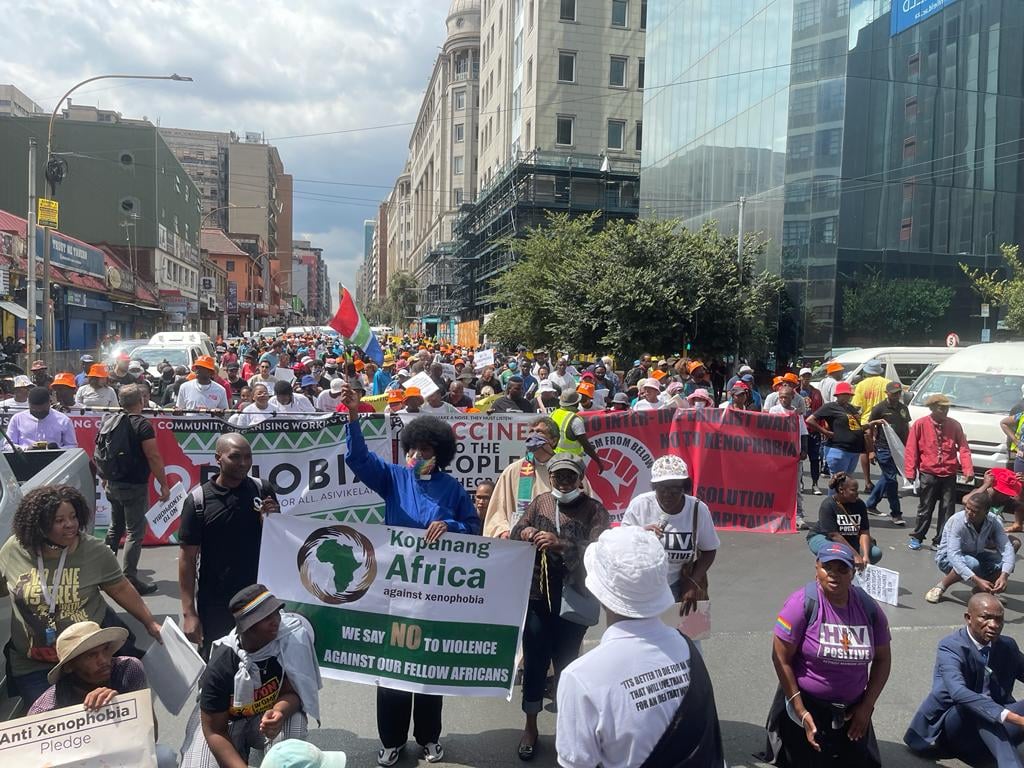
Kopanang Africa Against Xenophobia (KAAX) was created in February 2022, to try to respond to the rise of xenophobia. As they state on their web site: “We organize in communities; urban, formal and informal to advocate for unity among all who face inequality and marginalization. Our approach is rooted in solidarity not charity, empowering people to stand together across nationalities, genders, and backgrounds. Through assemblies, workshops, and community-based campaigns, we build collective power to demand better services, safety, and social justice.”
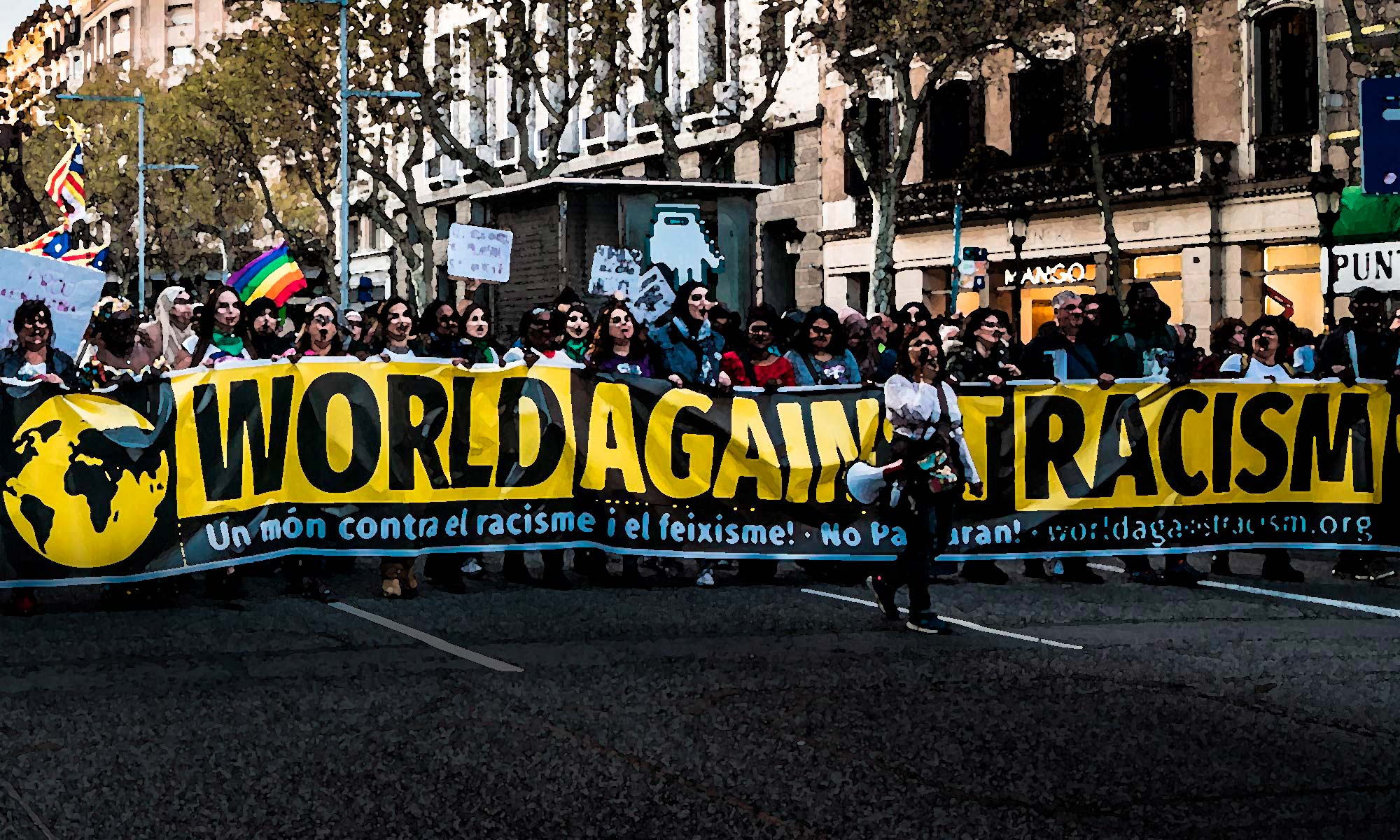
They presented the movement in public through four different actions — including lively demonstrations in both Cape Town and Johannesburg — organised in the context of the international mobilisation called by World Against Racism for March 2022. The Johannesburg demonstration in could only go ahead after defeating an attempt by the city police to ban it (Metelerkamp 2022).
By mid-April 2022, over 50 civil society organisations had already joined KAAX.
Mike Ndlovu explains that KAAX works through a general organising group and specific working groups (WG):
- Media WG —coordinated by Mike himself— responsible for press campaigns, social media etc.
- Humanitarian WG, which responds to aggressions, disasters, etc. These include cases where migrants are sleeping on the street, having had to flee from their houses, or where migrants’ children are (illegally) excluded from school.
- Political Education WG, which organises workshops, to explain to people what’s happening, to increase political consciousness.
- Mobilisation WG, which encourages the different organisations to participate in actions.
- Legal/litigation WG, which has taken the government to court to prevent the victimisation and harassment of migrants.
Mike maintains that KAAX’s work has been effective, especially on the ground:
“We’ve been able to mobilise and educate communities, also establish some coalitions, so if groups come to promote anti migrant rhetoric, they can push them back. We warn people against the Government anti-migrant rhetoric. We explain that migrants are part of our community and that we mustn’t listen to a middle class person who comes to tell us what it is happening in our township.”
“But it’s tough going. Look at social media, you can see that these groups are well funded, they are promoting hate, with fake accounts that change the narrative, over Twitter/X. The mainstream media also promote this sort of discourse, they want to please their bosses and those who finance them.”
“So we are doing good work, but we have no funding, we depend on volunteer work.”
Mike highlights how xenophobic attacks have been directed against Spaza, the informal shops in townships, often run by African migrants. They accuse them of selling out of date products, causing food poisoning. Mike points out:
“The food chain is controlled by big business, they run the whole system. Spaza shops provide cheap and convenient essential items, in place of the big shops, which are directly owned by big capitalist companies. So we think these companies encourage this harassment of the local shops, so they can take control of the township economy.”
There is massive youth unemployment in South Africa. Over 60% of those aged 15-24 are looking for work, while 3.9 million young people (37.6% of this age group) are not in employment, education or training (NEET).
In this context, KAAX had to condemn “the reckless and dangerous statements made by ANC Youth League President, Collen Malatji, in which he threatens to ‘clean out’ communities and ‘take up arms’ against people he labels as ‘illegal foreign nationals’.”
As KAAX commented:
“international migrants constitute approximately 3–5% of South Africa’s population. To blame this relatively small segment of society… is not only factually incorrect, but a deliberate misdiagnosis of South Africa’s deep structural crises. This scapegoating… represents a disturbing revival of apartheid-era ‘divide and rule’ politics.” (KAAX Media Team 2026).
Mike also insists on the role of some businesses in promoting the xenophobic vigilante groups:
“Who organises these groups? It’s capitalists who want to exploit people. The Government ignores the problem of xenophobic attacks and ignore the warnings we send about these groups. Vigilante groups have a lot of money, someone is funding them: they run paid campaigns on Facebook, Twitter, etc. There are definitely interests in play.”
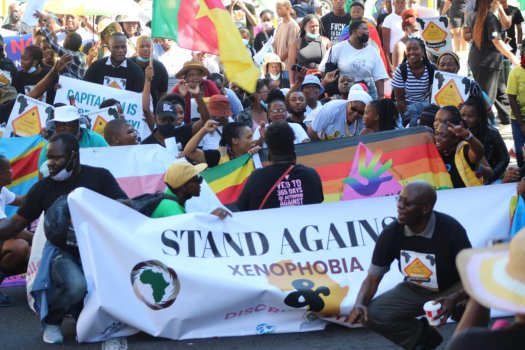
Even so, from the beginning there were signs of the effectiveness of KAAX’s strategy. Already in June 2022, KAAX could report from a protest at the market in Yeoville, a neighbourhood of Johannesburg, where an attack on migrants planned by Operation Dudula was prevented:
“They were faced with the unity of South African citizens and African migrants defending the traders in Yeoville, and so they realised that they could not stir division.” (facebook.com/KopanangAfrica, 14/06/22)
Repercussions and conclusions
The grave situation in South Africa is a stark reminder that the problem of racism and the growth of far-right ideas is not limited to Europe or the global north, nor does it only involve white people.
KAAX and other movements in South Africa refer to the promotion of hatred against African migrants by Black South Africans as xenophobia, rather than racism. However, the lies and stereotypes are almost identical to those promoted by racist forces in Europe, accusing migrants of crime and drug trafficking; of causing unemployment, a shortage of housing and insecurity in general; of abusing social services…
The way institutional parties echo such racist rhetoric is also sadly familiar. This means that, like in the global north, there are two parallel but different struggles: both against far-right organisations and against state racism.
In this context, the fact that KAAX has applied and adapted to local conditions the model of united action against racism and the far right is very positive.
A joint declaration of KAAX and many other forces in May 2026, against an action by “M & M”, expressed a key argument of the global united network in the face of the far right: “We refuse the lie that M & M is supported by and speaks for many, let alone a majority of South Africans. It is easy to fake support in the age of social media and targeted patronage” (KAAX and others 2026). As the global call for united protests in March 2026 insisted: “Those of us who oppose fascism and racism are the majority” (World Against Racism and Fascism 2026).
The difficulty of the situation means there can be no decisive and final blow against xenophobia in the short term, but specific battles can be and have been won.
In November 2025, KAAX won a sentence, by the Gauteng Division of the High Court in Johannesburg, which prohibited Operation Dudula and its members from intimidating, harassing, or assaulting individuals identified as foreign nationals, unlawfully evicting them from their homes or businesses, etc. Making the authorities enforce this sentence is another matter.
Other successes are more low profile —neighbourhood initiatives to stop xenophobic incursions, building alliances, etc., such as actions mentioned in the previous section— but these are a key part of the work.
We should leave the last word to Mike Ndlovu:
“We obtained a court order compelling the Government to protect all residents, whatever their nationality, as called for by the South African constitution. But that court order isn’t being enforced. The Government wants to scapegoat migrants in order to cover real problems. About 90% of the wealth is in the hands of 5% or so of population. It was like that under apartheid, and now under ANC it’s the same. Unemployment is rising, but ANC policies only favour the rich, the top class, that’s why they try to put the blame on migrants.”
Key points
- The problem of the far right and racism/xenophobia is worldwide.
- Local conditions can vary widely, and as a result, specific tactics must vary, but the general strategy of unity works.
- Often, decisive victories with headlines are difficult to obtain, but the day-to-day struggle is essential and can be effective over time.
Sources
- Interview with Mike Ndlovu, KAAX Communications officer and representative on the World Against Racism and Fascism coordinating group, by video call on 26/05/26.
- Anders, Tannur (2024), “Which parties make up South Africa’s unity government?”, reuters.com, 24/06/24. https://www.reuters.com/world/africa/which-parties-make-up-south-africas-unity-government-2024-06-24/
- Charlie, Ayanda (2023), “Inside South Africa’s Operation Dudula: ‘Why we hate foreigners’”, BBC.com, 18/09/23. https://www.bbc.com/news/world-africa-66808346
- KAAX and others (2026), “Cape Town does not want March & March”, 21/05/26. https://drive.google.com/file/d/13adhGO0DFEwn9SZzZg4hwyPjdP60rKmS/
- KAAX Media Team (2025), “High Court Interdicts OD from Hate Speech and Vigilantism”, kaax.org.za, 04/11/25. https://kaax.org.za/kopanang-africa-against-xenophobia-high-court-victory/
- KAAX Media Team (2026), “KAAX Condemns ANC Youth League President’s Incitement to Violence and Distortion of Facts” in kaax.org.za, 08/01/26. https://kaax.org.za/kaax-condemns-anc-youth-league-presidents-incitement-to-violence-and-distortion-of-facts/
- Makwetu, Ncebakazi (2026) “Denying SA is xenophobic: sounds like Trump’s Maga”, ufh.ac.za 01/06/26. https://www.ufh.ac.za/news/opinion-denying-sa-is-xenophobic-sounds-like-trumps-maga
- Maseko, Nomsa (2026), “South Africa condemns ‘fake videos’ of alleged xenophobic attacks”, BBC.com, 07/05/26
- Metelerkamp, Tamsin (2022), “Anti-Xenophobia march to go ahead Saturday after Joburg court overturns metro police prohibition”, dailymaverick.co.za, 25/03/22. https://www.dailymaverick.co.za/article/2022-03-25-anti-xenophobia-march-to-go-ahead-saturday-after-joburg-court-overturns-metro-police-prohibition/
- Ndzengu, Nobathembu (2022), “Photos, Anti-xenophobia march in Cape Town”, elitshanews.org.za 25/03/22. https://elitshanews.org.za/2022/03/25/photos-anti-xenophobia-march-in-cape-town/
- Ramaphosa, Cyril (2026), “President Cyril Ramaphosa addresses nation on illegal migration and anti-foreigner protests”, YouTube, 07/06/26. https://www.youtube.com/watch?v=CmECv9vdifY
- World Against Racism and Fascism (2026), “Call for global mass action: Stop racism and fascism!” March https://worldagainstracism.org/waraf2026/waraf2026-en/
- Xenowatch (2019), Xenophobic Violence in South Africa: 1994-2018: An Overview. https://www.xenowatch.ac.za/wp-content/uploads/2019/03/Xenophobic-Violence-in-South-Africa-1994-2018_An-Overview.pdf
- Xenowatch (2026), “Xenophobic Discrimination is a Regular Reality in South Africa”, Press Release, 04/05/26. https://www.xenowatch.ac.za/wp-content/uploads/2026/05/Xenowatch_Press_Release_04.05.2026_FIN.pdf


2 Replies to “Kopanang: working together against xenophobia in South Africa”